


'/%3E%3C/svg%3E)
Press tour “Low-Carbon Construction: Forest Tour”: foresters in Lviv region demonstrated responsible forest management practices in line with the FSC® Standard
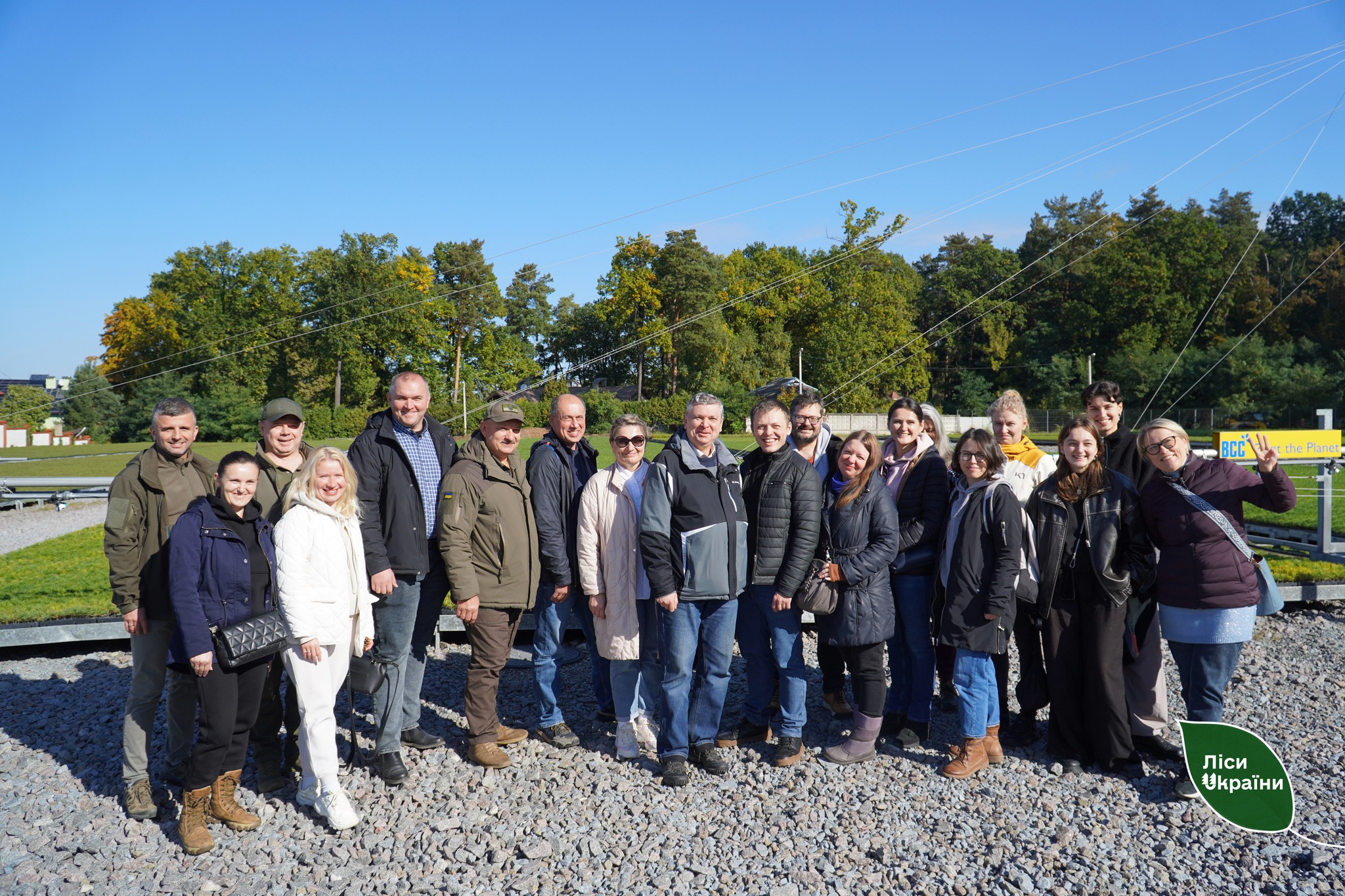
Representatives of the international non-governmental organization FSC (Forest Stewardship Council) Ukraine and specialists from SFE “Forests of Ukraine” conducted a two-day press tour for journalists, architects, designers, foresters, wood processors, and all interested participants. The event showcased responsible forest management practices in accordance with FSC standards in Ukraine.
Discussions focused particularly on the potential of wood as a renewable material for achieving low-carbon construction goals and ensuring the supply of certified forest products to consumers.
On October 9, the first day of the tour, participants visited the Lviv Forest Seed Selection Center of the “Forest Reproductive Resources” branch.
There, Taras Chikhrak, Assistant Head of the Lviv Forestry Management Unit of the «Karpatskyi Forest Office» branch, and Halyna Domashovets, Head of the Forest Certification Sector of the Ecosystem Services and Recreation Department at SFE “Forests of Ukraine”, presented key information about the enterprise — the largest forest user in Ukraine — using the Lviv Forestry Management Unitas an example.
Experts emphasized the importance of sustainable and responsible forest management based on close-to-nature forestry principles.
“In today’s conditions, we must respond to multiple factors: climate change, transformation of forest-growing conditions, the need to balance economic, social, and environmental interests, legislative and regulatory changes, the ongoing transformation of Forests of Ukraine, the effort to maintain FSC certification across new structural units, and, of course, the war in Ukraine — all these influence forest management. Therefore, close cooperation between our foresters’ practical experience and experts’ scientific approach is key to responsible management. The combination of forestry expertise and research-based insight enables us to develop effective procedures that transform valuable forest areas into resilient ecosystems capable of meeting modern challenges”, – emphasized Taras Chikhrak.
Pavlo Kravets, National Representative of FSC Ukraine, noted that thanks to this low-carbon construction forest tour, media representatives and architects had the opportunity to discover responsible forestry through the lens of FSC certification.
“This tour marks another important step forward in increasing transparency in the forestry sector, showcasing best practices that meet FSC standards, and promoting the importance of balancing ecological, economic, and social interests. We commend the efforts of Forests of Ukraine in meeting public expectations for preserving and enhancing the country’s forest heritage while contributing to low-carbon construction and green recovery,” – said Pavlo Kravets.
Media, architects, and designers were shown the process of growing seedlings of main forest-forming species and learned about all the stages a seed goes through before becoming a mighty forest.
At the Lviv Forest Seed Selection Center, where for over ten years seedlings with closed root systems (CRS) of main forest species have been cultivated, specialists are currently caring for Crimean pine seedlings — a future resource for forest restoration in southeastern Ukraine.
The growth cycle of a standard seedling lasts 2–3 years, from seed harvesting to packaging and planting in forest areas. Tour participants observed all stages of this process — from seed to final product.
At the Richkivske Forestry’s permanent nursery, foresters also demonstrated the difference between cultivating seedlings in open soil and in special containers. This allowed journalists and designers to learn about forest growing in the Malyi Polissia region, characterized by sod-podzolic, gray forest, and peat-bog soils. Each tour participant contributed to forest restoration by planting young seedlings in the forests of Lviv Region and observed tree growth stages — from three to one hundred years old.
A separate focus of the tour was on natural forest regeneration. Foresters explained that while natural regeneration is a priority method of close-to-nature forestry, it does not always occur effectively. Factors such as climate change, pest or disease damage, and dense ground vegetation (e.g., brambles) can hinder natural regrowth. In such cases, foresters complement unwooded areas with seedlings, combining the advantages of natural and artificial regeneration. This approach helps form resilient mixed stands with diverse age structures, ensuring the ecological stability of forest ecosystems.
“Obtaining an FSC certificate by the forestry branches of the Carpathian Forest Office is not just about including the certification code in accompanying or trade documents.It is solid proof that the enterprise ensures a balance of economic, social, and environmental requirements in forest management. Moreover, it obliges forest users to engage with stakeholders when making key management decisions. Simply put, certification confirms the international recognition of forest products and the fact that the forest is of legal origin, managed in a way that conserves biodiversity, benefits local communities and employees, and sustains its economic potential,”– emphasized Halyna Domashovets.