


Ukrainian foresters adopt Latvia’s expertise: innovations in seed preparation for forest restoration and closed root system seedling production technologies
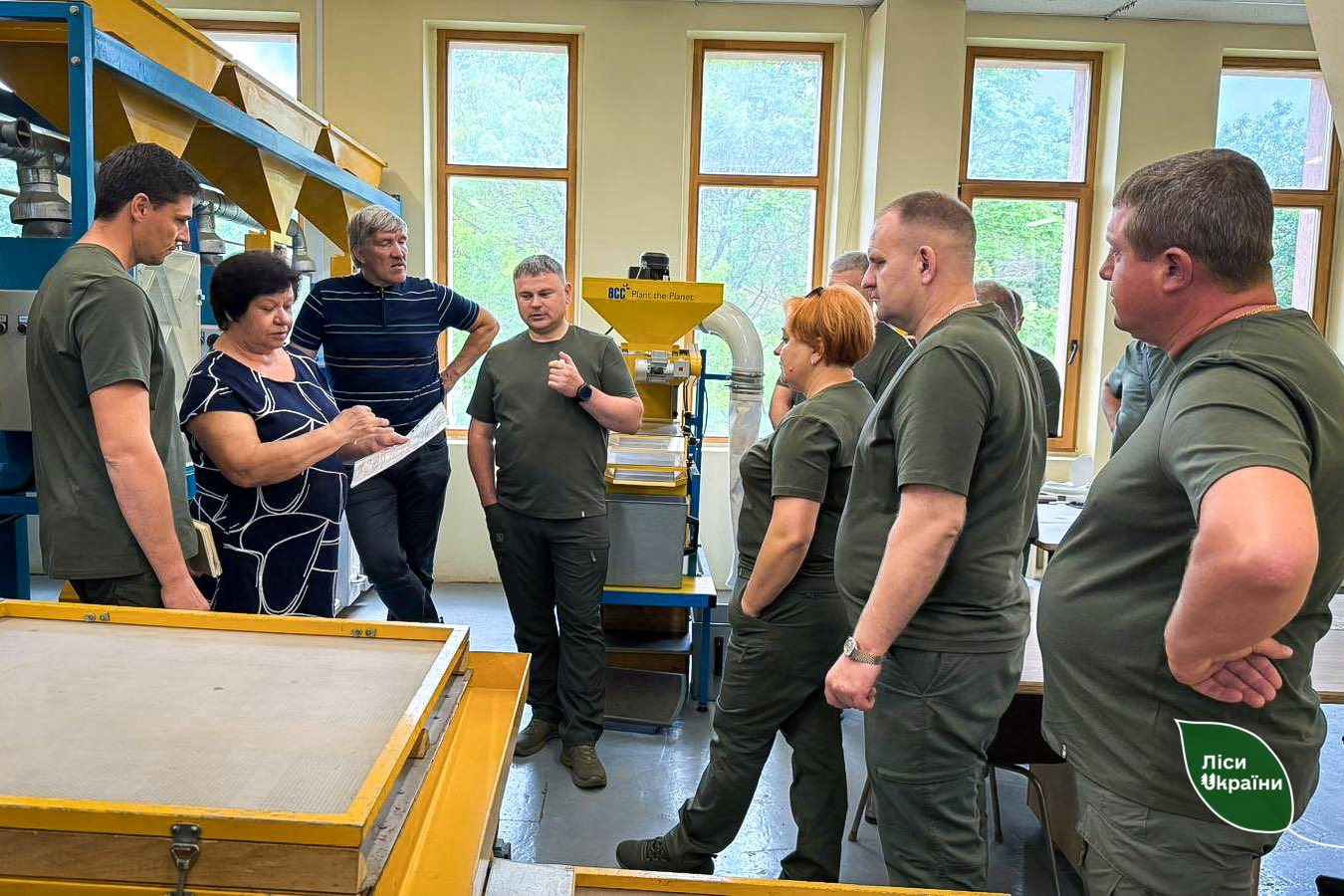
Representatives of the Branch “Forest Reproductive Resources” of SFE “Forests of Ukraine” visited JSC “Latvia’s State Forests” (LVM). At the meeting, the foresters exchanged experiences and discussed modern trends in seed preparation for cultivating higher‑quality timber.
Maris Druvaskalns, Director of LVM Seeds and Plants, acquainted the Ukrainian delegation with the enterprise’s organizational structure and the unit’s activities. The unit specialises in forest restoration using seedlings grown from locally sourced seed. Seed is collected from 62 forest seed plantations, covering a total of 800 ha across various regions of Latvia. These plantations have been designed to yield the most valuable genetic material.
What’s important?
1.Latvian foresters maintain seed reserves with a 13–20 year horizon.
Seed is stored in refrigerated storage chambers. Before placement, foresters perform extensive processing: they treat and dry the cones, extract the seed, and remove the winged appendages that hinder sowing and even distribution. The seed is then cleaned, washed, dried, and graded. Finally, it is sorted in a gravity separator, which separates fully filled, viable seeds from shrivelled, damaged, or empty ones.
The State Forest Service Laboratory of Forest Seed Control assesses seed quality. Only after receiving the control report is the seed placed in a refrigerated chamber for long‑term storage. It is kept in sealed containers at –4 °C. Under these conditions, pine and spruce seeds can remain viable for up to 20 years.
2.The Forest Research Station is equipped with cutting‑edge technologies, including sensors for monitoring air‑composition parameters.
In the state forests of Latvia, specialized scientific research is conducted at the Forest Research Station, which spans over 28,000 ha. Studies there focus on seedling survival rates, growth increments, and the selection and propagation of clones for seed plantations. For the purposes of these scientific investigations, the standard regulations governing timber harvesting, forest regeneration and afforestation, and protection against pests and diseases are not applied.
The station is equipped with two 45‑metre towers, each fitted with state‑of‑the‑art sensors that detect changes in air‑composition parameters and their impact on forest stands within a 4 km radius. Investment in each tower amounts to €2.5 million.
At the on‑site forest nursery, clonal planting stock is produced. Two greenhouses are outfitted with heated concrete floors, climate control (air conditioning), ultraviolet lighting, humidifiers, and automated irrigation systems.
Scientific and practical measures to obtain genetically high‑quality seed subsequently result in a 25 percent greater wood increment compared to conventional stands.
3.The unique “Long Nights” technology ensures optimal seedling height.
During their visit to the state‑of‑the‑art nursery LVM Mezvidu Rokaudzētava, the delegation from the Branch “Forest Reproductive Resources” of SFE “Forests of Ukraine” familiarized themselves with the unique “Long Nights” technology. This method artificially shades the seedlings in the growing fields, creating the illusion of autumn: each day, the plants are kept in complete darkness from 16:00 until 09:00 for three weeks. As a result, their growth slows, they lignify more rapidly, and they develop a terminal bud. This process produces seedlings of an optimal height (up to 15 cm) and significantly improves their quality for subsequent cultivation.