


EIA impedes remediation of forest disaster aftermath: delays lead to environmental risks and multimillion economic losses
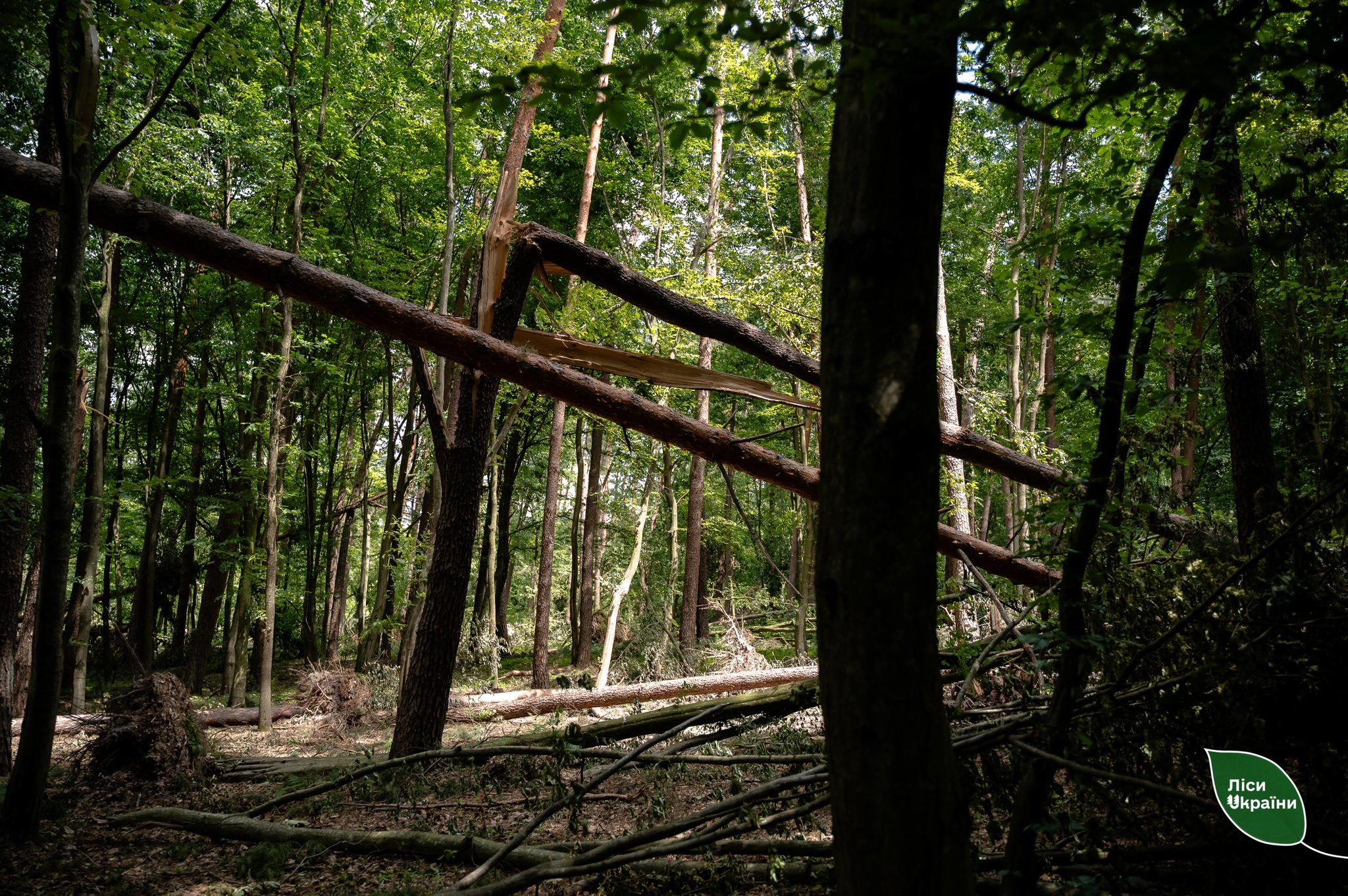
An on-site assessment of the storm’s aftermath in the Rivne Region was conducted directly in the forest. The field meeting was convened by Serhii Chupryna, Director of Branch “Poliskyi Forest Office” of SFE “Forests of Ukraine.” Participants included Volodymyr Buchko, First Deputy Head of the State Forest Resources Agency of Ukraine; Oleksandr Kokhan, Deputy Head of the Rivne Regional Military Administration; Mykola Kucheruk, First Deputy Chair of the Regional Council; Volodymyr Zakharchuk, Head of the Department of the State Emergency Service of Ukraine in the Rivne Region; Oleksandr Koshyn, Head of Branch “Rivnelisozakhyst” of SSFPE “Kyivlisozakhyst”; as well as ecologists, researchers, wood processors, and journalists.
WHAT IS THE PROBLEM
The storm destroyed over 700 hectares of forest in Kostopilske Forestry Management Unit. Yet, the enterprise cannot swiftly begin remediation of windthrow damage on more than 200 hectares—due to the legal requirement to undergo an Environmental Impact Assessment (EIA). This delay introduces a new set of risks: economic, environmental, and managerial.
Eighty-one forest plots across seven forestry units of Kostopilske Forestry Management Unit were affected. In eighteen plots, 90–100% of the stands were damaged—more than 200 hectares requiring clear-cutting. Another 63 plots exhibit damage levels of 25–80 %. Throughout many areas, trees were snapped in half or uprooted. The most severely affected species were pine, oak, alder, and birch.
LOSSES
The EIA procedure lasts at least 4–6 months and costs up to UAH 1 million. During this period, the timber loses its commercial quality. For pine, the share of merchantable assortments falls from 60 % to zero within five months. The same applies to birch and alder. Had remediation works begun immediately, the enterprise could have earned up to UAH 288 million in revenue. After the delay, only UAH 147 million will be recovered. Losses will total UAH 141 million, and the state will undercollect at least UAH 55.5 million in taxes and rent payments.
Serhii Chupryna emphasized the critical impact that delays in addressing the damaged areas have on the forest ecosystem and the economy: “We have hundreds of hectares of destroyed forest—this is not a planned harvest but the aftermath of a natural disaster. These are already environmental losses—significant areas have been affected. But right now, it is crucial to prevent economic losses and remove the timber in a timely manner. Yet this is impossible because of the requirement to undergo the EIA procedure.”
Volodymyr Buchko drew attention to the contradiction between the law’s intent and its effect in emergencies: “This is a case where a law designed to protect the environment instead creates new threats. We need legislative flexibility in such circumstances, and we are working on it.”
Oleksandr Kokhan highlighted the economic losses and risks to local communities: “This storm is not only an environmental disaster but an economic one as well. We must act swiftly and within the law. This issue concerns not only the forestry and wood-processing sectors but also the environment and the stability of local budgets. The quality of the timber declines by the day. If we delay, we will exacerbate fire risks and economic losses. We are working together with all levels of government.”
Oleksandr Savytskyi emphasized the critical situation for the wood-processing sector: “We specialize, among other things, in processing high-quality birch and alder—precisely those species that very quickly lose their merchantable properties. And right now, when the timber market is in acute need of additional volumes, losing this valuable resource to bureaucratic hurdles is absurd. This is a blow not only to producers but to the entire economy, which requires stability and rapid decisions.”
The State Emergency Service and ecologists warn of an elevated risk of forest fires. Scientists caution that the damaged areas provide an ideal environment for pest proliferation. Without timely intervention, there is a risk of disease spread to healthy stands.
An obvious solution, but lost opportunities
In cases of natural disasters, the EIA procedure almost always yields a positive conclusion. Yet even this predictable formality is delayed, consuming time and money. Every month of postponement translates into losses—of resources, finances, and environmental integrity.
As a result of the meeting, it was agreed to prepare joint appeals to the Verkhovna Rada and the Cabinet of Ministers of Ukraine regarding the regulation of procedures for addressing the aftermath of emergency situations in forests.